Home / Baccarat / Baccarat Third-Card Rule: The Drawing Table Explained
Mechanics
The baccarat third-card rule, decoded.
The rule looks like a wall of numbers until you separate it into two questions: did Player draw, and if so, what was Player’s third card?
Updated
First principle
You do not choose whether to draw in standard punto banco. The rule is procedural. Learning it helps you understand the game, not outsmart the dealer.
Player rule
Player two-card total
Action
0–5
Draw
6–7
Stand
8–9
Natural; no draw
Banker rule when Player stands
If Player stands on 6 or 7, Banker generally draws on 0–5 and stands on 6–7. Naturals end the procedure before this point.
Banker rule when Player draws
Banker total
Banker draws when Player’s third card is…
0–2
Always
3
Anything except 8
4
2–7
5
4–7
6
6–7
7
Never
A memory aid that actually explains the structure
As Banker’s starting total gets stronger, the set of Player third cards that trigger a Banker draw gets narrower: almost everything at Banker 3, then 2–7 at 4, 4–7 at 5, and only 6–7 at 6.
That pattern is easier to retain than memorizing isolated cells.
Three hands that show the rule at work
Each hand below was dealt in a fixed order and settled by the same rule engine our tools use. Read the steps, then check them against the tables above.
Banker 3 stands against a Player 8
3 vs 8
Player 3
2♠3♣8♥
Banker 3
K♥3♦
Player gets 2♠ and 3♣: 2 + 3 = 5.
Banker gets K♥ and 3♦: 0 + 3 = 3.
Player has 5. Player draws on 0 to 5 and gets 8♥ (worth 8), for a total of 3.
Banker has 3. Banker on 3 draws unless Player’s third card is an 8. The card was 8, so Banker stands.
Tie, 3 to 3. Player and Banker bets push.
Why: Banker on 3 draws to every Player third card except an 8. The 8 is the one card that leaves Player holding a strong total far more often than not, so the table has Banker stand.
Banker 6 draws against a Player 7
6 vs 6 or 7
Player 2
4♣A♠7♦
Banker 1
9♥7♣5♠
Player gets 4♣ and A♠: 4 + 1 = 5.
Banker gets 9♥ and 7♣: 9 + 7 = 16, which counts as 6.
Player has 5. Player draws on 0 to 5 and gets 7♦ (worth 7), for a total of 2.
Banker has 6. Banker on 6 draws only when Player’s third card is a 6 or 7. The card was 7, so Banker draws.
Banker’s third card is 5♠, for a total of 1.
Player wins, 2 to 1.
Why: Banker on 6 draws only when Player’s third card is a 6 or 7. Those are the cards that can lift Player to 6 or 7, close enough to Banker’s 6 that a draw pays off for Banker.
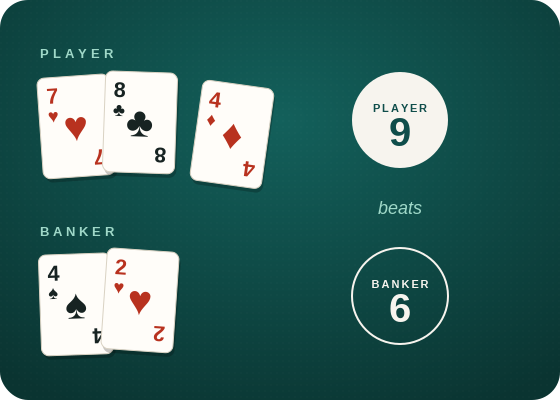
Player stands on 7, so Banker draws on 5
Player 6 or 7
Player 7
Q♦7♥
Banker 6
3♠2♣A♥
Player gets Q♦ and 7♥: 0 + 7 = 7.
Banker gets 3♠ and 2♣: 3 + 2 = 5.
Player has 7. Player stands on 6 or 7.
Player stood, so Banker follows the simple rule: draw on 0 to 5, stand on 6 or 7. Banker has 5 and draws.
Banker’s third card is A♥, for a total of 6.
Player wins, 7 to 6.
Why: Player stands on 6 or 7. With no Player third card to read, Banker falls back to the simple rule: draw on 0 to 5, stand on 6 or 7.
Why the table looks the way it does
The drawing table isn’t a strategy anyone at the table can change. It’s a fixed procedure, and it was set so that Banker, who acts second and can see Player’s third card, draws when a card is likely to help and stands when it isn’t.
That small information edge is the whole reason Banker wins more often. Over an 8-deck shoe, Banker wins 45.86% of hands, Player 44.62% and the rest are ties (9.52%). The 5% commission on Banker wins exists to balance that out, and it leaves Banker at a 1.06% house edge against 1.24% on Player. The full counts are in our baccarat reference tables.
Try it: does Banker draw?
Ten seconds a question. Each one is checked against the Banker table above, and the answer tells you which line of the rule applies.
Player’s third card is worth 8. Banker has 3. Does Banker draw?
Answer: Banker stands. Banker on 3 draws unless Player’s third card is an 8.
New to the game? How to play baccarat covers the scoring and the order of the deal before any of this matters.