The edge belongs to the ruleset, not to the word “blackjack.”
Two tables can look identical while offering meaningfully different expected returns.
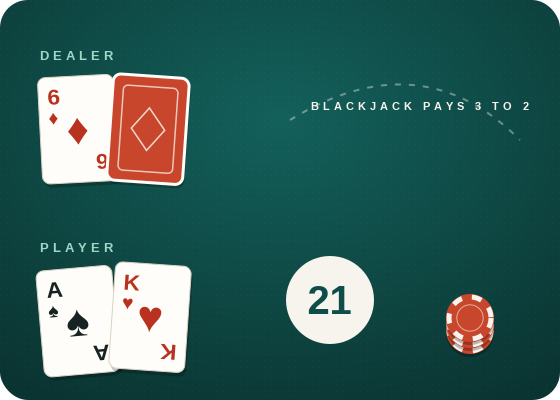
Updated
For one commonly analyzed six-deck game where the dealer stands on soft 17, correct basic strategy can reduce the house edge to roughly four-tenths of one percent. Change the rules and the figure changes.
Rules worth recording
| Rule | Why it matters |
|---|---|
| Blackjack pays 3:2 or 6:5 | Changes the value of the strongest starting hand. |
| Dealer S17 or H17 | Changes dealer drawing behavior and strategy. |
| Number of decks | Changes card composition and some strategy decisions. |
| Double after split | Affects value of splitting opportunities. |
| Surrender | Adds an exit option in selected poor situations. |
| Resplit / split-ace rules | Changes pair value. |
Avoid fake precision
A page that says “blackjack has a 0.5% house edge” without stating its rules is incomplete. Baccaret will attach assumptions to every strategy table, calculator or comparison.
Small wording on the felt can be worth more than a flashy table minimum.
Effects below are measured relative to a standard U.S.-style game using eight decks, dealer stands on soft 17, double on any first two cards, double after split allowed, and splitting to four hands. Positive values help the player; negative values help the house.
| Rule change | Approx. effect on player return | Practical reading |
|---|---|---|
| Blackjack pays 6:5 | −1.39% | A major deterioration; far larger than many smaller rule tweaks. |
| Dealer hits soft 17 | −0.22% | Worse than S17 under otherwise comparable rules. |
| No double after split | −0.14% | Removes value from profitable split situations. |
| Double only on 10–11 | −0.18% | Restricts profitable doubling opportunities. |
| Late surrender offered | +0.08% | Small but real value when used correctly. |
| Resplit aces allowed | +0.08% | Improves a narrow but valuable situation. |
| Six decks instead of eight | +0.02% | Small change by itself. |
| Double deck instead of eight | +0.19% | Meaningful, assuming other rules remain equal. |
Why 6:5 deserves disproportionate attention
Players often compare deck count while missing the natural-blackjack payout. The published effect of moving from 3:2 to 6:5 is roughly a 1.39 percentage-point hit to player return under the stated comparison—large enough to overwhelm several favorable minor rules combined.
Do not add rule effects blindly
These are useful directional approximations, not a substitute for calculating the complete ruleset. Interactions and strategy changes matter. A final house-edge estimate should come from the actual combination of rules being offered.
Baccaret table-check order
Check the blackjack payout first, then S17/H17, double-after-split, surrender, doubling restrictions, resplitting rules, deck count, and any unusual dealer-blackjack procedure.
Source note
Rule-effect benchmarks are based on the current Wizard of Odds blackjack rule-variation tables, reviewed August 2026.